
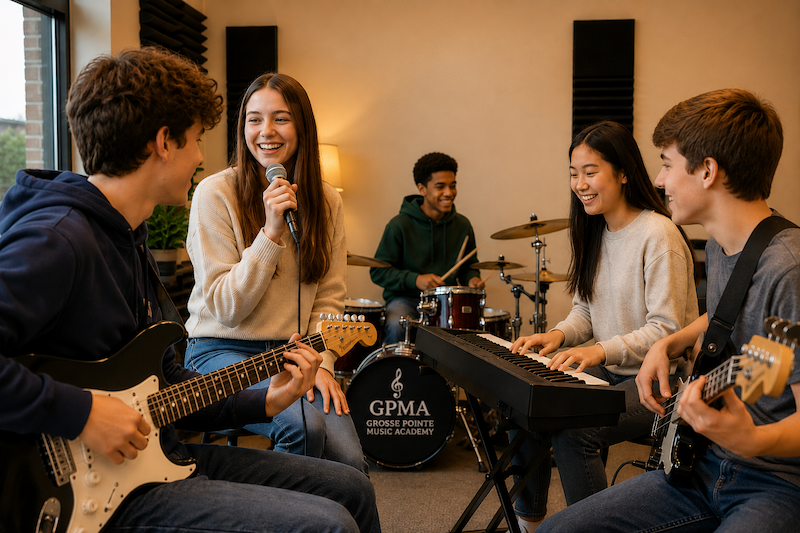
Private music lessons are one of the best ways to build technique, confidence, and individual skill. But at some point, something special happens when students begin playing music with other people.
Whether it’s performing a duet, joining a choir, playing in a Rock Band, or simply making music with a friend, students begin to experience something that can’t quite be recreated when practicing alone.
Music stops feeling like practice.
It starts feeling like the game.
Listening Becomes Just as Important as Playing
When students practice alone, it’s natural to focus on their own notes.
The moment another musician joins in, everything changes.
Now they have to listen.
They begin paying attention to timing, dynamics, phrasing, balance, and how their part fits with everyone else’s.
Music becomes a conversation instead of a monologue.
Timing Improves Naturally
One of the biggest improvements we see when students begin playing with others is rhythm.
Keeping a steady beat suddenly matters much more because everyone depends on one another.
Students quickly discover they’re no longer playing only for themselves.
They’re responsible for helping the entire group stay together.
Music Comes Alive
There is something difficult to describe that happens when rhythm and harmony come together.
It’s almost like magic.
Students who have only practiced alone often don’t realize what they’ve been missing until they hear their part become part of something bigger.
That’s one of the reasons group playing often creates such a noticeable surge in enthusiasm.
Confidence Grows Faster
We see it every year in our Rock Band Camps and other group programs.
Students who were hesitant during private lessons suddenly begin smiling, taking musical chances, and encouraging one another.
Playing with others builds confidence in a completely different way than practicing alone.
Many students return to their private lessons with renewed excitement and a much stronger understanding of music.
Responsibility Changes Everything
Playing with other musicians teaches accountability.
You’re no longer operating on your own schedule.
Everyone depends on everyone else.
You learn to count carefully.
You learn when to lead.
You also learn when not to play.
Those lessons stay with musicians for life.
Music Is a Conversation
People often say music is a language.
Playing with other musicians proves it.
Depending on the style of music, one instrument asks a question while another answers.
The bass supports the harmony.
The drummer shapes the feel.
The pianist or guitarist fills out the chords.
The singer tells the story.
Students begin understanding not only their own role, but everyone else’s as well.
That understanding also makes improvisation, arranging, songwriting, and music production much more natural.
You Don’t Have to Be an Expert
One of the biggest misconceptions parents and students have is that you need to become an advanced musician before playing with other people.
That simply isn’t true.
Some of the biggest musical breakthroughs happen when students begin playing with others much earlier than they expected.
Even making music with one other person can be incredibly valuable.
Private Lessons and Group Playing Work Together
Group playing doesn’t replace private lessons.
Private lessons are where students improve their individual technique, fix bad habits, strengthen weak areas, and continue developing as musicians.
Playing with others gives students an opportunity to apply those skills in real musical situations.
The two experiences complement one another beautifully.
The Bigger Picture
The best musicians aren’t simply the ones who can play the most notes or the fastest solos.
They’re the musicians who feel the song in their soul and invite the other musicians—and ultimately the audience—into the experience with them.
That’s something every student can begin learning the moment they start making music with other people.
Leave a Reply