
Grosse Pointe Music Academy
When parents notice differences in music lesson progress speed, it’s natural to wonder why some students seem to move faster than others. The truth is, progress in music doesn’t happen at the same rate for everyone — and that’s completely normal.
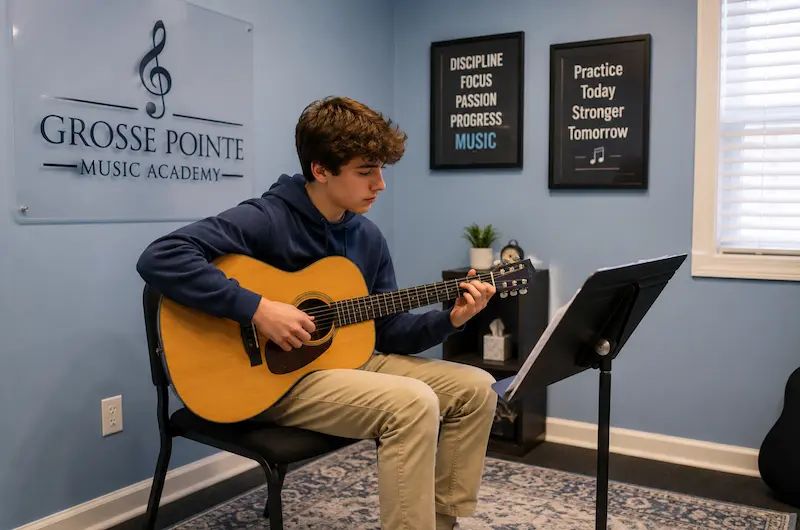
Why Music Lesson Progress Speed Varies Between Students
Every student begins with a different combination of:
- Coordination
- Listening skills
- Focus
- Practice habits
- Confidence
- Personality
Some children pick up rhythmic patterns quickly.
Others develop tone beautifully but take longer to read music.
Some are naturally steady. Others need time to settle in.
Speed early on does not determine long-term success.
Time Invested Matters
Sometimes what looks like “natural ability” is simply time.
A student who practices consistently five days a week will move differently than one who practices once.
That isn’t talent.
That’s repetition.
Music responds to exposure.
The more time spent at the instrument — thoughtfully and patiently — the more connections the brain builds.
Maturity Plays a Role
Age and emotional maturity matter more than people realize.
A nine-year-old may move differently than a seven-year-old.
A teenager may suddenly surge after months of steady, quiet development.
Adults often expect rapid progress — and become frustrated when it doesn’t happen immediately.
But learning something new requires humility.
Music has a way of reminding us that growth takes time.
Fast Starters vs. Steady Builders
Some students begin quickly.
They seem confident.
They learn songs fast.
They look comfortable early.
That’s wonderful.
But early speed doesn’t guarantee long-term depth.
Other students move steadily.
Not flashy.
Not dramatic.
But consistent.
Those steady builders often develop strong foundations that support lasting skill.
In music, longevity matters more than quick starts.
Why Comparing Music Lesson Progress Speed Can Be Misleading
It’s easy to compare.
Recitals, videos, other students — the temptation is everywhere.
But comparison usually steals focus from what matters most:
Is your child improving compared to their past self?
That’s the only comparison that truly counts.
Music is not a race. There is no finish line where students line up to see who arrived first.
There is only growth.
Confidence Builds From Skill
Sometimes students who move slowly at first end up finishing strong.
Why?
Because confidence doesn’t come from being labeled “talented.”
It comes from earning competence.
From struggling with something difficult.
From sticking with it.
From finally hearing it click.
That kind of confidence is durable.
And it stays.
What Parents Should Watch For
Instead of speed, look for:
- Increased comfort at the instrument
- Cleaner rhythm
- Better tone
- More independence
- Less hesitation
Progress often shows up quietly before it becomes obvious.
The Bigger Picture
Music is a long-term discipline.
The students who thrive are rarely the ones who moved the fastest at the beginning.
They are the ones who:
- Stayed consistent
- Kept showing up
- Worked through plateaus
- Built skill patiently
If your child is growing — even steadily — they are exactly where they need to be.
And that’s more than okay.
Understanding music lesson progress takes time. Learn more about what to expect, how growth develops, and how consistency builds real skill.
Related Articles
Leave a Reply