
Grosse Pointe Music Academy
When families enroll in music lessons, the goal is usually simple:
Learn piano.
Play guitar.
Sing better.
Keep rhythm.
But something else happens along the way.
Music quietly teaches things that have nothing to do with scales, chords, or songs.
And over time, those lessons matter just as much.
Discipline — Without It Feeling Like Punishment
We’re not talking about rigid, ruler-on-the-knuckles discipline.
We’re talking about something parents recognize:
The ability to sit down and do something difficult.
The ability to repeat something until it improves.
The ability to work toward something that doesn’t happen overnight.
Music teaches delayed gratification.
A child practices something basic — sometimes boring — and weeks later it suddenly works. That cause-and-effect relationship builds maturity in a very natural way.
Kids who grow up able to commit to something over time become capable adults. They learn that progress comes from effort, not magic.
Music reinforces that quietly, week after week.
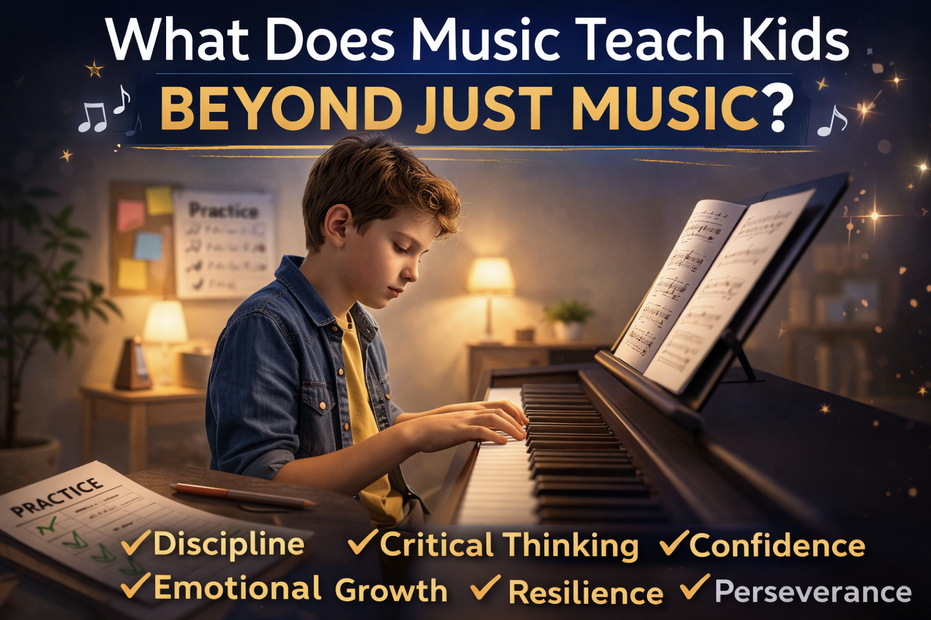
Critical Thinking and Mental Flexibility
There are countless studies suggesting that music supports cognitive development — especially in areas like:
- Pattern recognition
- Memory
- Sequencing
- Spatial reasoning
- Listening skills
But even without the research, you can see it happen.
Reading music is like learning a second language.
Keeping rhythm requires focus and internal counting.
Playing with others demands awareness and adjustment.
Music asks the brain to process multiple layers at once.
That kind of thinking carries over into academics and problem-solving naturally.
Confidence That Comes From Skill
Confidence doesn’t appear out of nowhere.
It grows from competence.
When a student can sit at an instrument and play something recognizable — something real — something shifts internally.
They know they earned it.
That kind of confidence is different from praise-based confidence. It’s skill-based confidence.
And skill-based confidence lasts.
Not every student becomes a performer. Recitals are always optional. Some musicians love the stage. Others prefer creating privately.
But even preparing for a small performance builds resilience. It teaches:
- Managing nerves
- Preparing for a goal
- Completing something start to finish
And when students do perform — even briefly — the confidence jump is noticeable.
Emotional Regulation
Music also gives kids something many activities don’t:
A constructive outlet.
Good day? Play.
Bad day? Play.
Frustrated? Play.
Calm? Play.
Learning an instrument provides structure without being competitive in the traditional sense. It gives students control over something personal.
For some kids, that outlet becomes extremely important as they mature.
The Ability to Stay With Something
One of the most powerful long-term benefits of music lessons is this:
Students learn not to quit immediately when something feels hard.
Early on, progress is slow.
There are plateaus.
There are moments of boredom.
Working through those moments builds perseverance.
And that skill transfers everywhere — school, sports, work, relationships.
The goal isn’t to create professional musicians.
The goal is to raise capable people.
Independence Over Time
In the beginning, parents are involved.
Over time, something changes.
Students:
- Practice on their own
- Track their own progress
- Choose music they want to work on
- Take ownership
Music slowly shifts from being something parents manage to something students own.
That transition is powerful.
It’s Bigger Than an Activity
At first glance, music lessons look like just another extracurricular.
But over years, the benefits compound.
Students develop:
- Patience
- Focus
- Listening skills
- Resilience
- Creative thinking
- Confidence built from effort
Not every student becomes advanced.
Not every student becomes a performer.
But almost every student who sticks with it grows in ways that extend far beyond music itself.
That’s why we encourage families to think long-term.
The skills build quietly — and they build for life.
Learn more about long-term growth, performance opportunities, and our private lesson programs.
Related Reading
Popular Private Lesson Programs in Grosse Pointe
Our Sister Music Academies
Leave a Reply