
What is the Most Common Guitar Tuning?
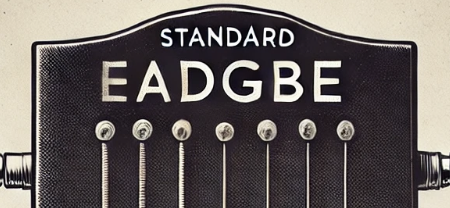
Standard tuning, used on classical, acoustic, and electric guitars, is often criticized as being arbitrary or randomly chosen at some point in history. However, upon closer examination, it turns out to be the best option for balancing versatility in both chord formations and scale navigation across the fretboard. When considering what is the most common guitar tuning, it’s clear that standard tuning remains the most practical and widely used choice due to its ability to accommodate a broad range of musical styles and techniques.
Standard tuning, EADGBE, might seem perplexing at first glance, especially to beginners. A novice can quickly observe the criticism by noting that the interval distance between each string is uniform—except between the 3rd (G) and 2nd (B) strings. This break in consistency can be confusing. However, understanding a bit of music theory helps to clarify why this happens.
In standard tuning, the interval between most strings is a perfect 4th: from E to A, A to D, D to G, and B to E. But between the 3rd (G) and 2nd (B) strings, the interval is a major 3rd. This major 3rd exception is essential for a practical reason: it allows the 1st string (high E) to match the pitch of the 6th string (low E). This alignment significantly influences the player’s ability to form chords and play scales smoothly across all six strings.
Additionally, when we examine the notes in standard tuning, we discover that they fit into both the G major and E minor pentatonic scales. The major scale is a seven-note system from which three different pentatonic scales can be derived, each consisting of five notes. This means that the open strings of the guitar naturally contain notes from three major scales: C, G, and D major. This intrinsic alignment with these scales makes standard tuning exceptionally practical, as it accommodates many common musical keys.
Moreover, there’s another benefit to standard tuning that beginners can appreciate: the open strings create helpful landmarks. For example, strings 4 (D), 3 (G), and 2 (B) form a major chord, while strings 3 (G), 2 (B), and 1 (high E) form a minor chord. These chord patterns make it easier for guitarists, especially beginners, to start navigating the fretboard. The alignment of the strings offers useful reference points, allowing players to easily form common chords without needing to shift too much across the neck of the guitar.
The pentatonic scale is just one of many possible five-note combinations that can be derived from the major scale. I believe the reason this particular five-note pattern became known as ‘The Pentatonic Scale’ is because it’s the only combination that omits both the minor 2nd (half-step) and the augmented 4th/diminished 5th interval. These dissonant intervals are avoided in the pentatonic scale, which is what gives it its distinct, consonant sound and widespread use in various musical styles.
In conclusion, while some may criticize standard tuning as arbitrary, it is far from random. The arrangement of intervals, including the major 3rd exception, allows for easy access to chords and scales across the fretboard, making it highly versatile. The connection between the open strings and the G major and E minor pentatonic scales further highlights its practicality. Ultimately, what is the most common guitar tuning? It’s the tried-and-true standard tuning, EADGBE, which continues to be the most widely used tuning for classical, acoustic, and electric guitars alike due to its balanced blend of simplicity and versatility for players of all levels.
Music Theory Resources
Explore more music theory topics, tools, and guides:
Want help applying this in real music?
Learn with structured guidance in our guitar lessons or piano lessons.
Book a Lesson
Leave a Reply